

🧱 Setup & Foundations
We kicked off the week by setting up our blog — the new home for all things OpenKuber: documentation, tech deep dives, and public delta logs.You can now follow along with our product iterations and research updates directly at blog.openkuber.com. Our docs and blog now live side-by-side.
🚀 Plugin Launch & Feedback Loop
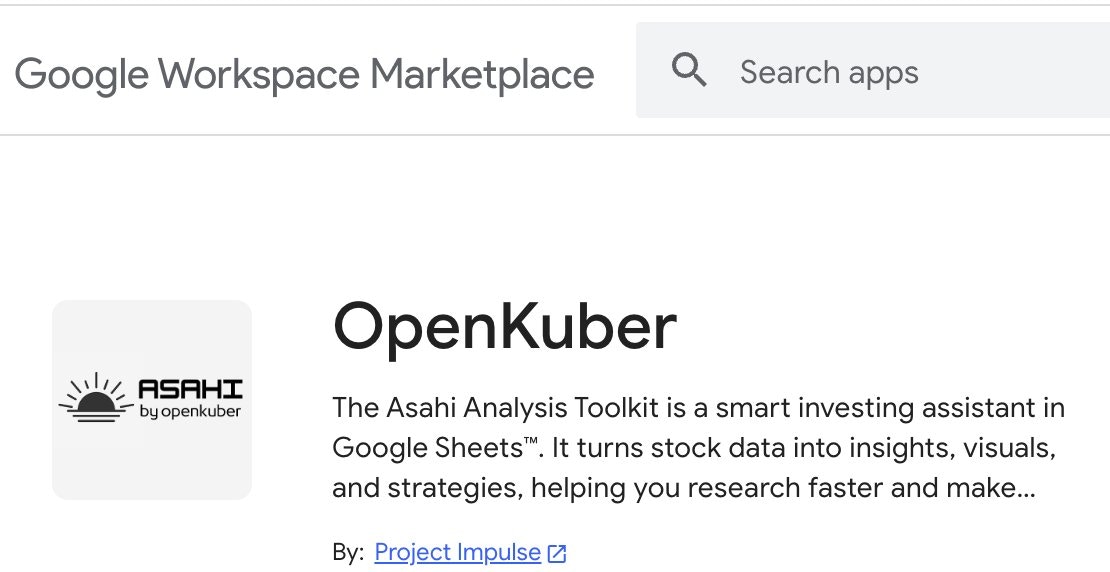
After applying for marketplace release, we gathered feedback from friends and family, refined our UX, and finally moved the plugin from draft to public. We also reached out to 8 ICPs (Ideal Customer Profiles) for more structured feedback — which led to design changes that are now implemented. We’re now moving on to another set of ICPs for the next round of iterated feedback and design validation.“User feedback drives clarity — and design iteration is where clarity meets craft.”
OpenKuber Google Sheets™ Add-On
🤝 Design Partnerships & B2B Outreach
This week, we began reaching out to RIAs (Registered Investment Advisors) to explore design partnerships and B2B use cases. These conversations are helping us shape how OpenKuber can serve financial professionals with precision and depth.🎥 Product Storytelling
We spent time refining our one-liner and elevator pitch, turning both into short video showcases that visually represent our message and intent. This was also the week we published our manifesto — the “why” behind OpenKuber.It outlines our ideological roots and long-term vision for democratizing structured financial insight. A manifesto video is also in the works — designed to make our story more experiential.
Our Manifesto
🧠 Causal AI Development
We formalized our Causal AI roadmap, broken into three key steps:- Data Preparation — already implemented during plugin setup, now fine-tuned for causal discovery.
-
Causal Discovery — currently being polished and configured for tighter integration.
 A trading strategy backtest can be viewed as a causal machine where every step is a precise causal link, moving information forward through time. It begins withdata formation by looking back at the historical price data (e.g., $t-k$ to $t$) to calculate technical indicators (like RSI or MACD) at the current time, $t$. These technical indicators form the inputs for causal graph discovery.
These variables at time $t$ are used to generate a trading signal and, subsequently, an order size. The most crucial link is the temporal causality: the executed trade at $t$ is the direct cause that forces a definitive change in the portfolio’s state (position, cash, value) at the immediate next timestamp, $t+1$. Finally, the portfolio’s value at $t+1$ is the direct cause of the resulting performance and risk metrics (like drawdown) establishing a Directed Acyclic Graph from historical market inputs to future performance outcomes. - Causal Inference — in planning phase, being mapped out conceptually before implementation.
📈 Marketing & Early Reach
We ran a few Twitter and YouTube experiments to test early engagement and organic reach — and the numbers look promising. The focus remains on authentic storytelling and community-driven feedback. Thanks for following along. Every week, we’ll share transparent updates as we build in public — step by step.🔗 Follow Our Journey
- 🐦 Twitter: @OpenKuber_Sxnk
- 📺 YouTube: OpenKuber Channel